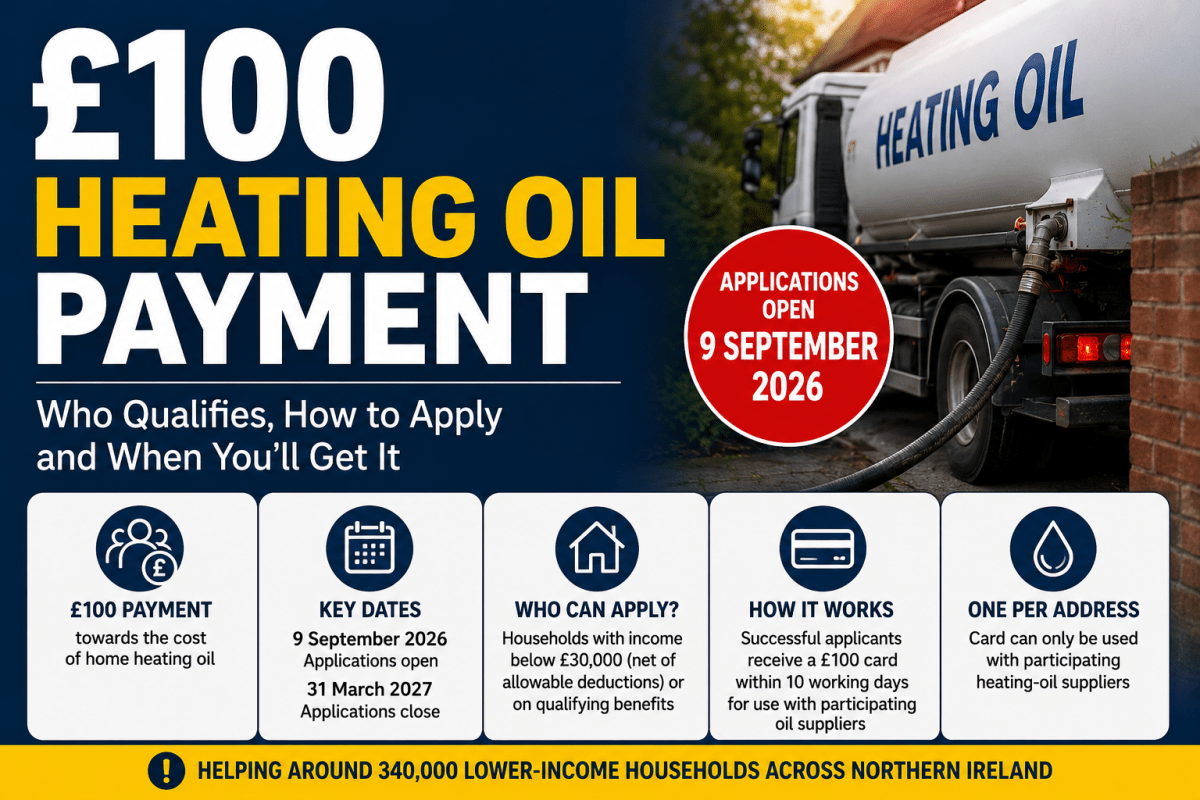
Hundreds of thousands of households across Northern Ireland could receive £100 towards the cost of home heating oil, as families continue to face pressure from higher energy and everyday living costs.
Around 340,000 lower-income households are expected to qualify for the Home Heating Oil Support Scheme, with applications opening in September.
At a glance
– Payment: £100 towards home heating oil
– Applications open: 9 September 2026
– Applications close: 31 March 2027
– Households potentially eligible: Around 340,000
– Income route: Annual household income below £30,000, net of allowable deductions
– Benefit route: Certain income-related or disability benefits can qualify
– Heating requirement: Oil must be the household’s main source of heating
– Payment method: £100 card for use with participating heating-oil suppliers
– Limit: One payment per address
– Expected processing: Payment card normally issued within 10 working days following a successful application
Who could qualify?
Households may qualify through either their income or receipt of certain benefits.
Eligibility includes:
– Single people or couples with annual household income of less than £30,000, after allowable deductions
– People receiving certain income-related benefits
– People receiving qualifying disability benefits
– Households must use oil as their main source of heating
Qualifying benefits include schemes such as:
– Universal Credit
– Pension Credit
– Income Related Employment and Support Allowance
– Personal Independence Payment (PIP)
– Disability Living Allowance (DLA)
– Attendance Allowance
Applicants should check the full official eligibility criteria before applying.
How do you apply?
Applications will open through NI Direct on Wednesday 9 September.
The scheme will remain open until 31 March 2027.
The Department for Communities expects more than 75% of applications to be processed automatically, although some applicants may need to provide additional evidence.
This could particularly affect some lower-paid self-employed workers who do not currently receive benefits.
Why is the payment being introduced?
The £100 scheme comes as Northern Ireland households continue to deal with a wider cost-of-living squeeze.
While inflation has fallen substantially from the levels experienced during the worst of the cost-of-living crisis, that does not mean prices have returned to where they were several years ago.
Instead, many everyday costs remain considerably higher.
UK CPI inflation increased to 2.9% in July 2026, meaning prices overall were continuing to rise.
For households whose wages or benefits have not kept pace with increases in food, housing, transport and energy costs, household budgets remain under considerable pressure.
Why has heating oil become so expensive?
Northern Ireland is particularly vulnerable to heating-oil price increases.
Official figures show around 61% of NI households use oil as their primary heating source.
The escalation of conflict involving Iran during 2026 caused major disruption and uncertainty in international energy markets.
The Competition and Markets Authority found average heating-oil prices increased dramatically:
– February: approximately 64p per litre
– March: approximately 104p per litre
– April peak: approximately 123p per litre
That represents an increase of around 92% between February and the April peak.
The CMA found that the overwhelming majority of the initial increase was linked to rising wholesale costs rather than simply increased margins by heating-oil suppliers.
Prices have since fallen considerably from their peak — but they remain substantially higher than before the latest energy shock.
What does £100 actually cover?
Latest Consumer Council figures from 25 August show the average cost of heating oil in Northern Ireland at approximately:
– 300 litres — £280.67
– 500 litres — £453.44
– 900 litres — £804.42
That means the £100 support represents only around 22% of the current average cost of a 500-litre oil delivery.
There is another striking comparison.
An average 500-litre delivery cost around £307.38 on 26 February.
It now costs around £453.44.
That’s an increase of approximately £146.
In other words, the entire £100 government payment would not cover the increase alone in the average price of a 500-litre oil fill since February.
Why Northern Ireland is particularly exposed
Northern Ireland’s reliance on heating oil means international energy shocks can quickly find their way into household budgets.
Unlike households paying monthly gas or electricity bills, people buying heating oil can face a large bill every time their tank needs filled.
For example:
– A 500-litre fill currently averages more than £450
– Around 61% of NI households rely primarily on oil
– Oil prices can react rapidly to changes in international markets
– Northern Ireland households therefore have significant exposure to global oil-price shocks
Events thousands of miles away can ultimately change what a family in Newry, South Armagh or elsewhere in Northern Ireland pays to heat their home.
The wider cost-of-living squeeze
Energy is only one part of the pressure facing households.
Lower-income families have to cover essential expenditure including:
– Food
– Electricity
– Home heating
– Rent or mortgage costs
– Transport
– Insurance
– Rates
– Childcare and other household essentials
Consumer Council research has previously found Northern Ireland’s lowest-income households can have less than £52 per week remaining after essential expenditure.
That helps explain why even relatively small increases in energy or food prices can have a significant effect on household finances.
More than £50 electricity support also planned
A separate measure could provide additional help with electricity costs.
Plans currently envisage more than £50 in electricity support for every Northern Ireland household.
The important difference is:
– £100 heating oil support — eligible households must apply
– £50+ electricity support — expected to be automatic for all households
The electricity support is expected to begin from October 2026.
However, the final arrangements remain subject to Treasury approval.
Key dates to remember
– 9 September 2026 — £100 heating-oil scheme opens
– October 2026 — £50+ electricity support expected to begin, subject to Treasury approval
– 31 March 2027 — heating-oil scheme closes
The bottom line
The £100 payment will provide welcome support for hundreds of thousands of households, but the figures demonstrate the scale of the continuing pressure.
An average 500-litre oil fill now costs around £453, approximately £146 more than in late February.
For households already struggling with food, electricity, transport and other essential costs, the latest energy-price shock has added another substantial expense.
With around 340,000 households potentially eligible, anyone who heats their home with oil should check the eligibility criteria when applications open on 9 September.
Clanrye News will publish the application details and direct application information when the scheme opens.
ENDS
 CLANRYE NEWS